Lo spettacolo di Marco Paolini, La macchina del capo, è appena finito e mi sono messa di corsa a scrivere per non perdere l'emozione.
A me Paolini, o anche solo Marco, l'ha fatto conoscere Ste che, come al solito, più silenziosa della media, sa avere idee chiare e lasciare tracce indelebili. Se non ricordo male, il primo spettacolo che abbiamo visto insieme fu I-Tigi. Racconto per Ustica e da allora spesso, forse quasi sempre, quando sto per salire sulla scaletta di un aereo me li ricordo questi Tigi, me li immagino, che corrono per salire per primi, per prendere un posto che, il più delle volte, è stato già assegnato e anche se il volo è low cost (opzione non prevista nel 1980) il posto c'è comunque. Hanno facce diverse ogni volta e io, a dire la verità, nemmeno le guardo, ma sono sempre loro: I-Tigi.
Poi è stata la volta di Vajont, visto alla tv, in cucina con Sa, che la prima volta che sono andata a trovarla a casa sua mi ci ha portato a vedere davvero la diga, a vedere quanto è alto dal parapetto della diga giù fino alla cima della terra che si è accumulata dopo la frana.
Poi c'è stato Parlamento chimico, visto sempre al Rossetti, a Trieste: una lunga difficile tirata tra chimica e finanza. Indimenticabile quando a un certo punto, facendo pensare ad alta voce l'operaio che accompagna lo scienziato dentro agli stabilimenti del petrolchimico di Marghera, questi dice "Però, per essere un dottore, uno che ga studià, ne dice di bestemmie questo... Diossina!".
L'ultima volta, dal vivo, sempre al Rossetti, Il Sergente, la commozione che ti fa sentire ogni volta ogni storia come se fosse anche un po' tua.
Nel mezzo, ci sono stati, sparpagliati qua e là, Gli Album - quelli dove dopo una serata di baldoria, "eravamo in quindici stesi per terra in piazza, sette e mezzo per la questura" e Bhopal e altri...
Tutto questo per arrivare a un punto: si nasce narratori. E quello che fa il narratore è la sua sincerità, quella che porta con sé ancora pudore, ma non vergogna.
Non so se sono narratore, ma credo che mi piacerebbe esserlo. Un narratore lo ricordi per la sua sincerità, perché ha un "tocco", ma sa essere tanto trasparente da far ricordare la storia più che la propria abilità.
Visualizzazione post con etichetta Come un romanzo. Mostra tutti i post
Visualizzazione post con etichetta Come un romanzo. Mostra tutti i post
giovedì 1 gennaio 2009


domenica 15 luglio 2007
Renato Soru, i costruttori e la letteratura
The saviour of Sardinia
An internet billionaire may sound like an unlikely conservationist. But Renato Soru has made it his mission to save the island of his birth from the ravages of the developers. Peter Popham reports from Gavoi
An internet billionaire may sound like an unlikely conservationist. But Renato Soru has made it his mission to save the island of his birth from the ravages of the developers. Peter Popham reports from Gavoi
The hills of Barbagia, the wild sheep-rearing country in the dead centre of Sardinia is a place where normally almost no-one ever goes. Mention La Barbagia to an Italian and the first thing that comes to mind is kidnapping: this was until recently a famous centre of brigandage, and the thinness of the population made it ideal for squirrelling away the victims.
Barbagia is also rich in archeological remains: it has an extraordinary number of neolithic stone towers, nuraghi in Sardinian, dolmens, giants' tombs, menhirs, the so-called "domus de janas" or "houses of the fairy witches", egg-like tombs carved out of the rocks where tribal leaders were laid to rest in the foetal position.
It also has wonderful wine, cheese and prosciutto, a culinary tradition as rich as anywhere in Italy, and local people happy to tell you all about it. What it has lacked - until now - has been visitors.
The resorts on Sardinia's beautiful coast are packed with tourists, local and foreign. The Costa Smerelda, developed by the Aga Khan in the 1960s, is a playground for Europe's rich and glamorous.
The interior, by contrast, with its rocky mountain slopes and forests of cork oak and empty roads, is almost virgin terrain. But visitors are beginning to beat a path in their thousands to the hills of Barbagia, for "L'isola delle storie", "Island of stories", a literary festival in a village called Gavoi, one of the more unlikely places in the world to find people talking about books. The man chiefly responsible is an internet billionaire called Renato Soru.
Renato Soru is Sardinia's most celebrated businessman, a supermarket owner who branched out with dazzling success into internet services, founding Tiscali and becoming the most important internet player in Italy. In 2003, at 46, he decided to go into politics, launching "Project Sardinia" on the centre-left, committed to checking the despoliation of the coastline by what he called "savage tourism".
One year later, Mr Soru swept to power as president of the Sardinian region. His first act, to the fury of the developers, was to freeze all building within two kilometres (1.25 miles) of the coast. "This is a measure that will protect Sardinia and Sardinians for the next 500 years," he said.
But conservation of what remains of the coastline was only one part of his vision: the other was to restore vitality to the island's interior. "Now a different model of development is possible," he says, "one that is based on the culture of the local people."
He was not the only person who dreamed of revitalising Sardinia's interior.
Andreuccia Podda was born and raised in the village then went away to university. But she did not want to become a permanent migrant to the city like so many other Sardinians. "I like living here," she said, "and when I graduated from university I decided to come back here to live. But when you live in a place that is so small and remote, where there is no entertainment and nothing ever happens, you have to do something to survive.
"So in 2001 a group of us who like reading got together and decided to organise some events. On Saturday evenings once a month throughout the winter, from September to March, we invited a different writer to the village to give a reading, usually in one of the village bars ... It was just something to do on a Saturday night. After the reading we all got together with the writer in one of the restaurants and had dinner. And that was it.
"We decided we wanted to do something bigger, so in November 2001 we formed an association, 26 of us, including 10 writers, to create some kind of a literary event. We invited one of the organisers of Mantova's famous literary festival to come over for a weekend and give us her thoughts and when she saw what we had planned she just said, carry on, that's terrific."
At about the same time in Cagliari, the Sardinian capital, a group of writers with roots in the island got together and dreamed a dream. "We know the beautiful and the ugly of festivals," said Marcello Fois, a novelist and screenwriter who is now director of Gavoi's literary festival.
"I was invited once to a festival in Spain where I was deposited in my hotel room for several hours, taken to the festival to make my presentation, then taken straight back to the hotel again and that was that. There are festivals where there is no possibility of meeting people, no warmth between the authors and the public. One evening at dinner in Cagliari we said to each other that we wanted to launch a festival which was different, where intelligence, affection and the joy of meeting people would come together, a festival where people don't just come but they stay, a sort of bubble that would be a vacation from stupidity, where intelligent things can be said."
Fois and his friends cast around for the best place to root the event they had conceived. The desperate housewives of Gavoi meantime were dreaming their own dream of turning the monthly readings into something more substantial.
And then up popped Renato Soru. Despite his money - in 2000 he was listed in 99th place on Forbes's billionaire list, with an estimated fortune of $4.3bn - he was an unlikely politician. You would never call him charismatic: he was and remains painfully shy. He speaks in a soft monotone, as if talking to himself; unlike every other Italian in the world, his hands remain motionless. But these handicaps were more than compensated by his advantages: his money, needless to say, but also his political vision for the island where he was born, and the courage he has shown in facing down the developers.
The nascent Gavoi festival was exactly the sort of thing Mr Soru wanted to encourage, even before his election. The Cagliari writers and the Gavoi enthusiasts found each other, Mr Soru's company, Tiscali, provided the seed money, and they were away.
Today L'isola delle storie, whose fourth edition finished this week, is being hailed as one of the most resounding new successes of Italy's cultural calendar.
It is also a pioneering example of what may be possible as concerned individuals such as Mr Soru come to power and try to redress the grotesque imbalances caused by the over-exploitation of the Mediterranean's coastlines. It is one of the Sardinian president's great themes: resort development has galloped across the island's beaches because it seemed to bring instant riches with it. This businessman is persuasive and articulate on how much of a mirage that has been, how the islanders are passive spectators or unskilled labourers in the tourist economy, how the profits are removed elsewhere - as Sardinia's mineral riches have been removed by centuries of predatory exploitation.
"The coastal economy will continue to be important," he said this week, "but the way it is going it risks killing off the culture of the interior altogether, creating a kind of city sprawling along the coastline while the rapid depopulation of the interior continues. We have to react to this, we have to create a counterbalance to what is happening on the coast."
As more and more of the Mediterranean is essentially destroyed by resort tourism, the message is bound to spread. Mr Soru's new role as "Ambassador for the Coasts" in the UN's Environment Programme gives him the chance to spread the word.
The Sardinians are still with him on this, he insists. "Of course there are critics and opponents of the policy of banning new construction on the coast," he said, "but the majority of Sardinians understand what is at stake."
Gavoi's festival is a concrete example of how to create a counterbalance. The festival has acquired a distinctly British slant, though nobody seems very clear why. Last year, Jonathan Coe and Allan Guthrie packed them in, this year Nick Hornby was top of the bill. The festival represents a flowering of the village itself. It has become a four-day excuse for the village to let its hair down. Via Roma, the main street, turns pedestrian for the duration, and its 23 bars stay open beyond midnight, thronging with locals as well as visitors.
Tiscali is still a sponsor, but now the region itself is its biggest backer, yet it is still struggling to pay its bills. "None of the organisers gets paid, said Fois. "If it seems rich it's because we exploit all the resources we have." The writers for example - they are not paid, either, not even Hornby, or the famous film director Ermanno Olmi, or the bestselling Italian comedian-turned-thriller writer Giorgio Falletti, or the photographer Gianni Berengo Gardin. The stars get rooms in a modest hotel beside the nearby lake; but they get the chance to hang out in the bars and restaurants, meet their readers and other writers, and have some country fun.
Until now Gavoi was known for its sheep, its cheese and its mutton. The village's other pleasures are equally rustic. One of its delights is the tinkling of sheep bells. The sound is so ubiquitous that the villagers no longer notice it, just as they look blank when you mention the scent of flowers which fills the village, and and the silence of the velvety night.
But now Gavoi has books as well, and modern art in the local museum, and stars of stage and screen standing in the local piazza taking questions. Villagers who have moved elsewhere and come back for a visit at festival time rub their eyes in disbelief.
President Soru turned up on Saturday night as Nick Hornby was doing his stuff. "Today people come to Sardinia for the sun and the sea," he said. "But by preserving our environment we are making an investment in our future. Sardinia is not just sun and sea, it is also silence and darkness. We have a hidden treasure here."
(by The Indipendent - 7 July 2007)
venerdì 27 aprile 2007
ALCATRAZ/2
Un uomo solo che guarda il muro è un uomo solo.
Ma due uomini che guardano un muro è il principio di un'evasione.
Ma due uomini che guardano un muro è il principio di un'evasione.
(Jack Folla)
Credere è una bella cosa
ma mettere in atto le cose in cui si crede
è una prova di forza.
Sono molti coloro che parlano come il fragore del mare,
ma la loro vita è poco profonda
e stagnante come una putrida palude.
Sono molti coloro che levano il capo
al di sopra delle cime delle montagne,
ma mettere in atto le cose in cui si crede
è una prova di forza.
Sono molti coloro che parlano come il fragore del mare,
ma la loro vita è poco profonda
e stagnante come una putrida palude.
Sono molti coloro che levano il capo
al di sopra delle cime delle montagne,
ma il loro spirito rimane addormentato nell'oscurità delle caverne.
(Khalil Gibran)
giovedì 26 aprile 2007
Vorrei scrivere una storia

Vorrei scrivere una storia in cui i personaggi non sono perfetti, ma della loro imperfezione sono così sicuri da poterla mostrare senza paura. Una storia in cui i personaggi si dicono le cose brutte in faccia, ma ancora di più si dicono le cose belle. Una storia in cui quando uno dei personaggi si innamora, o anche solo si prende una cotta, diventa luminoso e le campane suonano a festa perché l'amore è di per sé una cosa bella.
Vorrei scrivere una storia in cui un personaggio non vedente è una guida per quelli che hanno l'anima ottusa. Una storia in cui se uno dei personaggi piange, di gioia o di dolore, le lacrime servono per innaffiare le violette e farle crescere più belle perché un'emozione vera non è mai sprecata. Una storia in cui i personaggi si svegliano la mattina e trovano un caro/a amico/a che vive a 500 chilometri di distanza in cucina, pronto/a a far colazione.
Vorrei scrivere una storia che non abbia per forza un lieto fine, ma che semplicemente non abbia fine: si trasformi, diventi un'altra storia e poi un'altra e poi ancora un'altra... Una storia in cui i personaggi che parlano poco siano i più rispettati e un'aura li circondi indicando agli altri che vale la pena dare loro retta. Una storia in cui i personaggi abbiano un amplificatore dei battiti del loro cuore cosicché tutti si possano ricordare che ciascuno ha le sue emozioni e i suoi sentimenti.
Vorrei scrivere una storia in cui i personaggi possano essere alberi dalle radici ben salde e dai rami lunghi quel che serve per arrivare dove i loro sogni chiedono di essere.
A M&B e Mau... le mie radici.
A Mile, Ste e Sa... tra le persone che mi mancano di più.
A Chiara, Filo, Lisa, Roby, Teo, Luca e Mauri... tra i presenti.
A Mile, Ste e Sa... tra le persone che mi mancano di più.
A Chiara, Filo, Lisa, Roby, Teo, Luca e Mauri... tra i presenti.
venerdì 16 marzo 2007
Attenti alle donne che leggono
Attenti alle donne che leggono è il titolo di un articolo piuttosto divertente che ho trovato sul sito della Stampa, firmato da Daria Bignardi.
Potrebbe essere una cosa scritta da me... Libri, divano (anche se nelle case dove abito/ho abitato non c'era mai), letto, tazza di te, silenzio, naso tra le pagine fino a straore o in ogni secondo libero...
venerdì 3 marzo 2006
Latte alle ginocchia, ai gomiti...
Ci sono persone che hanno la capacità di farti venire il latte alle ginocchia. Prima dialogavo via sms con una di queste, cercando di farmi dare un si o un no - una risposta precisa - riguardo a quanto questa persona ha intenzione di fare tra un paio di giorni: cioè accettare o no un invito che gli ho fatto.
Ci sono voluti sei o sette sms, spalmati su giorni diversi per ottenere una risposta, ma la cosa migliore è che 'sto soggetto continuava a precisare il preciso! Dico, basta! Ma parlo italiano, si o no? Ok, la confusione mentale regna sovrana, forse, in questo momento ma certe cose non sono difficili da capire di per sè, mi pare...
A proposito, l'altro giorno ho finito di leggere Tre metri sopra il cielo. Mi chiedevo: ma Babi è diminutivo di Babbiona?
Ovviamente, dopo aver detto questo, non ammetterò mai che il libro mi è piaciuto e che alla fine ho pure pianto un po'.
giovedì 2 marzo 2006
Scusate se non monologo
Sabato sera sono stata ad ascoltare una lettura per beneficenza de I monologhi della vagina di Eve Ensler: i 3 € di ingresso andranno a sostenere campagne contro le violenze sulle donne.
L’ascolto è stato piacevole, brave le tre lettrici, anche considerando che erano un po’ emozionate e comunque non professioniste. Ma c’è un “ma”…
Alcune parti della lettura non mi sono piaciute perché, secondo me, esprimono l’idea che per essere donna, per sentirti tale, devi parlarne, quasi ad ogni costo. E a me sembra che questo genere di atteggiamento sconfini nella provocazione, nell’ostentazione. Questo non mi piace.
La sessualità è un ambito privato. È giusto parlarne. È necessario parlarne, ma la libertà si esprime appunto nello scegliere le persone con cui parlarne, con cui condividere questo aspetto, nello scegliere i tempi e i modi per farlo.
Non mi sento più libera se pronuncio ad alta voce una parola. Trovo estremamente riduttivo affermare: io sono la mia vagina. Perché, allora, non potrei identificarmi con il mio fegato, ad esempio? O con il mio cuore, piuttosto?
È che ho l’impressione che questo genere di atteggiamenti esprimano un’idea del corpo come composto di elementi separati: è una concezione tipicamente nostra, occidentale, quella di sezionare…
Con questo non voglio contestare le ragioni delle persone che hanno ideato questa serata, anche perché tutto sommato credo che il punto dove vogliamo andare a parare sia il medesimo: il rispetto per le donne, più ampiamente il rispetto reciproco tra le persone, riguardo ad una sfera importante della loro vita.
Però credo che il rispetto riguardi globalmente un soggetto e che il rispetto per se stessi si guadagna con il raggiungimento di un certo equilibrio interiore e, tuttavia, questo è un fenomeno soggettivo che ha tempi, luoghi e modi diversi per ciascuno. Non si può globalizzare il proprio rapporto con la sessualità. Non si può apprenderlo ad un seminario di gruppo. Io, personalmente, ne rivendico la sua privatezza.
E d’altra parte sono d’accordo con l’idea che probabilmente esiste ancora un tabù troppo grande su questo argomento che minaccia dall’interno i rapporti fra le persone. Ma si combatte la censura con l’ostentazione? E poi cosa conta di più: le parole o i fatti?
L’ascolto è stato piacevole, brave le tre lettrici, anche considerando che erano un po’ emozionate e comunque non professioniste. Ma c’è un “ma”…
Alcune parti della lettura non mi sono piaciute perché, secondo me, esprimono l’idea che per essere donna, per sentirti tale, devi parlarne, quasi ad ogni costo. E a me sembra che questo genere di atteggiamento sconfini nella provocazione, nell’ostentazione. Questo non mi piace.
La sessualità è un ambito privato. È giusto parlarne. È necessario parlarne, ma la libertà si esprime appunto nello scegliere le persone con cui parlarne, con cui condividere questo aspetto, nello scegliere i tempi e i modi per farlo.
Non mi sento più libera se pronuncio ad alta voce una parola. Trovo estremamente riduttivo affermare: io sono la mia vagina. Perché, allora, non potrei identificarmi con il mio fegato, ad esempio? O con il mio cuore, piuttosto?
È che ho l’impressione che questo genere di atteggiamenti esprimano un’idea del corpo come composto di elementi separati: è una concezione tipicamente nostra, occidentale, quella di sezionare…
Con questo non voglio contestare le ragioni delle persone che hanno ideato questa serata, anche perché tutto sommato credo che il punto dove vogliamo andare a parare sia il medesimo: il rispetto per le donne, più ampiamente il rispetto reciproco tra le persone, riguardo ad una sfera importante della loro vita.
Però credo che il rispetto riguardi globalmente un soggetto e che il rispetto per se stessi si guadagna con il raggiungimento di un certo equilibrio interiore e, tuttavia, questo è un fenomeno soggettivo che ha tempi, luoghi e modi diversi per ciascuno. Non si può globalizzare il proprio rapporto con la sessualità. Non si può apprenderlo ad un seminario di gruppo. Io, personalmente, ne rivendico la sua privatezza.
E d’altra parte sono d’accordo con l’idea che probabilmente esiste ancora un tabù troppo grande su questo argomento che minaccia dall’interno i rapporti fra le persone. Ma si combatte la censura con l’ostentazione? E poi cosa conta di più: le parole o i fatti?
lunedì 9 gennaio 2006
ALCATRAZ
Avete un po’ di sana rabbia in corpo? Ce l’avete?? SI o NO??? Prendete posizione, ragazzi. Prendete posizione perché tocca farlo tutti i giorni, se non volete finire k.o. prima del tempo…stesi da tutto quello che ti danno ad Alcatraz!
Sapete cos’è Alcatraz? No, non il carcere americano sull’isoletta a largo di San Francisco…In Italia, è stato una trasmissione radio di qualche anno fa che non andrà più in replica…Era la voce di Jack Folla, condannato a morte, a condurla. Adesso in libreria potete trovare la raccolta dei testi di quelle trasmissioni, s’intitola ALCATRAZ. Jack Folla, un d.j. nel braccio della morte. No, non è pubblicità. Fate quello che volete. Liberi di leggere o no. Però se quel po’ di rabbia ce l’avete ancora e di rassegnarvi non vi va giù, qui troverete la vostra rabbia espressa meglio che da voi stessi!
Alcatraz non è il luogo dove sta rinchiuso Jack. Alcatraz è fuori, dove stiamo noi.
Io non so se Jack Folla sia esistito davvero. Quando ho finito di leggere l’ultima pagina il dubbio m’è venuto, davvero. Suggestione? Mah…Probabilmente è solo una brillante invenzione di Diego Cugia – mio conterraneo, direi, a giudicare dal cognome – autore di romanzi, film e sceneggiati…però quello che c’è scritto là dentro – immaginazione o no – è vero. È VERO.
Penso però che sia stato un po’ un gioco crudele realizzare un’idea del genere…anche se Jack non è esistito in senso fisico…D’altra parte esiste in noi, almeno in qualcuno, speriamo in molti.
Io non sono d’accordo con tutto quello che dice, in alcune cose ho sentito il privilegio, reale, di poter guardare oltre. E poi di poter guardare qui, vicino, dove fa più male…
Ah, un’avvertenza: il suo linguaggio è sporco, duro e crudo. Vedete di andare oltre lo scandalo, c’è ben altro sotto per cui conservare l’indignazione.
Volete provare a vedere che prospettiva ha un albatro in volo?
Sapete cos’è Alcatraz? No, non il carcere americano sull’isoletta a largo di San Francisco…In Italia, è stato una trasmissione radio di qualche anno fa che non andrà più in replica…Era la voce di Jack Folla, condannato a morte, a condurla. Adesso in libreria potete trovare la raccolta dei testi di quelle trasmissioni, s’intitola ALCATRAZ. Jack Folla, un d.j. nel braccio della morte. No, non è pubblicità. Fate quello che volete. Liberi di leggere o no. Però se quel po’ di rabbia ce l’avete ancora e di rassegnarvi non vi va giù, qui troverete la vostra rabbia espressa meglio che da voi stessi!
Alcatraz non è il luogo dove sta rinchiuso Jack. Alcatraz è fuori, dove stiamo noi.
Io non so se Jack Folla sia esistito davvero. Quando ho finito di leggere l’ultima pagina il dubbio m’è venuto, davvero. Suggestione? Mah…Probabilmente è solo una brillante invenzione di Diego Cugia – mio conterraneo, direi, a giudicare dal cognome – autore di romanzi, film e sceneggiati…però quello che c’è scritto là dentro – immaginazione o no – è vero. È VERO.
Penso però che sia stato un po’ un gioco crudele realizzare un’idea del genere…anche se Jack non è esistito in senso fisico…D’altra parte esiste in noi, almeno in qualcuno, speriamo in molti.
Io non sono d’accordo con tutto quello che dice, in alcune cose ho sentito il privilegio, reale, di poter guardare oltre. E poi di poter guardare qui, vicino, dove fa più male…
Ah, un’avvertenza: il suo linguaggio è sporco, duro e crudo. Vedete di andare oltre lo scandalo, c’è ben altro sotto per cui conservare l’indignazione.
Volete provare a vedere che prospettiva ha un albatro in volo?
lunedì 5 dicembre 2005
Questa storia
A parte essere alquanto inca... oggi (e non nel senso dell'antico popolo dell'america latina), volevo dire che ieri notte ho finito di leggere Questa storia di Baricco.
Baricco è veramente un poeta. Io amo i libri, pressochè indiscriminatamente, e dunque voglio dire GRAZIE alle persone che me lo hanno regalato. Sia perché mi hanno fatto un regalo che non poteva non piacermi (è stata anche una sorpresa scoprire che era un libro, non me l'aspettavo...), sia perché era stato scelto con particolare cura. Infatti la curiosità di questo libro è di essere stato pubblicato con 5 copertine diverse e sul retro 5 frasi diverse prese dal testo: Il mio è stato scelto anche in base a questo criterio. Grazie ancora!:-)
Un'ultima cosa, ho scoperto che il 5% dei diritti d'autore andrà a sostenere un'opera di beneficenza. Visto che ultimamente mi sono votata alla causa del diritto d'autore (secondo Lessig, ovviamente) mi fa particolarmente piacere.
Bye bye!
domenica 10 luglio 2005
Immaginazione
Un giorno chiacchieravo con un amico a cui non piace particolarmente leggere (anche se ultimamente si è un po’ “riconvertito”) e mi ha spiegato che una delle ragioni per cui non gli piaceva farlo, era il fatto di non riuscire a immaginarsi i personaggi, le situazioni, i posti che venivano raccontati.
Questa cosa mi ha colpito molto…perché io invece, fino a quel momento, l’avevo data per scontata: credevo che fosse una capacità innata dell’essere umano!
Comunque sia, ho iniziato a rifletterci sopra e, per curiosità, ho iniziato a chiedere in giro alle persone che conosco come immaginano i personaggi dei libri...
Per esempio, secondo me, Benjamin Malaussène (uno a caso, tanto per cambiare…) somiglia un po’ a Pennac: è vero Pennac ha proprio l’aria da “professorino”, però Malaussène deve avere gli stessi capelli scuri, con lo stesso taglio “corretto” ma un po’ spettinato, me lo vedo alto e allampanato…che corre come un pazzo sotto la pioggia, attraversando i ponti di Parigi! Quest’immagine mi è venuta proprio così, mentre leggevo la descrizione di questa scena in Signor Malaussène.
Oppure, Alex di Jack Frusciante è uscito dal gruppo: mi spiace, ma nel film Stefano Accorsi sembrava il nonno di Alex! Doveva avere 16 anni…e ne dimostrava una ventina abbondante, se non una trentina! Aidi era sbiadita, invece: sembrava che Violante Placido non fosse molto convinta di voler fare quel personaggio…Va be’, ma questo è un altro discorso: il passaggio dal libro al film che, il più delle volte, lascia insoddisfatti.
Tornando a noi, l’ambientazione di Io non ho paura: giallo, sole, grano…molto probabilmente sono stata influenzata dal trailer (non ho visto ancora il film), ma ho comprato quel libro perché, al di là della storia, “avevo voglia” di quel genere di paesaggi, quelli tipici del Sud Italia, ma anche della Sardegna, quelli che vengono definiti mediterranei dove il verde è solo quello della macchia mediterranea e il resto, in questa stagione, è tutto giallo…ma giallo, di un giallo incredibile che fa contrasto con il cielo blu, dove non vedi una nuvola nemmeno a pagarla! E l’aria è tersa e vedi tutto così: giallo e blu, con qualche chiazza di verde, fino all’orizzonte! Fantastico…per me quella è l’estate e quelli sono i luoghi dell’estate (imprinting genetico, non c’è dubbio!).
Con Corto Maltese mi è capitato il contrario (ovviamente, sarebbe giusto dire…): ero curiosa di sapere che faccia avesse Hugo Pratt. Premessa: siccome nelle sue biografie si legge che ha avuto effettivamente una vita avventurosa, che ha viaggiato…lo incarnavo molto bene nella faccia un po’ “ladresca” e assorta di Corto.
Questa cosa mi ha colpito molto…perché io invece, fino a quel momento, l’avevo data per scontata: credevo che fosse una capacità innata dell’essere umano!
Comunque sia, ho iniziato a rifletterci sopra e, per curiosità, ho iniziato a chiedere in giro alle persone che conosco come immaginano i personaggi dei libri...
Per esempio, secondo me, Benjamin Malaussène (uno a caso, tanto per cambiare…) somiglia un po’ a Pennac: è vero Pennac ha proprio l’aria da “professorino”, però Malaussène deve avere gli stessi capelli scuri, con lo stesso taglio “corretto” ma un po’ spettinato, me lo vedo alto e allampanato…che corre come un pazzo sotto la pioggia, attraversando i ponti di Parigi! Quest’immagine mi è venuta proprio così, mentre leggevo la descrizione di questa scena in Signor Malaussène.
Oppure, Alex di Jack Frusciante è uscito dal gruppo: mi spiace, ma nel film Stefano Accorsi sembrava il nonno di Alex! Doveva avere 16 anni…e ne dimostrava una ventina abbondante, se non una trentina! Aidi era sbiadita, invece: sembrava che Violante Placido non fosse molto convinta di voler fare quel personaggio…Va be’, ma questo è un altro discorso: il passaggio dal libro al film che, il più delle volte, lascia insoddisfatti.
Tornando a noi, l’ambientazione di Io non ho paura: giallo, sole, grano…molto probabilmente sono stata influenzata dal trailer (non ho visto ancora il film), ma ho comprato quel libro perché, al di là della storia, “avevo voglia” di quel genere di paesaggi, quelli tipici del Sud Italia, ma anche della Sardegna, quelli che vengono definiti mediterranei dove il verde è solo quello della macchia mediterranea e il resto, in questa stagione, è tutto giallo…ma giallo, di un giallo incredibile che fa contrasto con il cielo blu, dove non vedi una nuvola nemmeno a pagarla! E l’aria è tersa e vedi tutto così: giallo e blu, con qualche chiazza di verde, fino all’orizzonte! Fantastico…per me quella è l’estate e quelli sono i luoghi dell’estate (imprinting genetico, non c’è dubbio!).
Con Corto Maltese mi è capitato il contrario (ovviamente, sarebbe giusto dire…): ero curiosa di sapere che faccia avesse Hugo Pratt. Premessa: siccome nelle sue biografie si legge che ha avuto effettivamente una vita avventurosa, che ha viaggiato…lo incarnavo molto bene nella faccia un po’ “ladresca” e assorta di Corto.
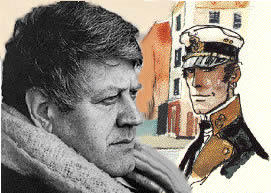
Ieri ho visto una sua foto, insieme a Vincenzo Mollica (il Mollicone del TG1!): signore con i capelli bianchi, ricci, panza ben curata, giacca e pantaloni in velluto marrone (almeno così sembra). L’avreste mai detto? Io, onestamente, no…Ma d’altra parte mi fa piacere perché è un’ulteriore prova del fatto che non sai mai cosa c’è nella testa della gente…Curiosità inarrestabile, di conseguenza!
In camera ho attaccato sull’anta dell’armadio, di fronte al mio letto, il viso di Corto (l’immagine è quella con cui Repubblica ha pubblicizzato l’uscita del fumetto nella Serie Oro qualche mese fa): l’immagine del volto non è completa, anche se è frontale, e quando lo guardi fa un “effetto Monna Lisa”, sembra sempre ricambiarti lo sguardo. E ha sempre l’espressione giusta per ogni occasione…
Menomale che non è un tema, se no oggi sarei andata fuori traccia a ripetizione…Be’ comunque…W LA LIBBERTÀ, come direbbe Gian Burrasca!!
Iscriviti a:
Post (Atom)


